May 11, 2026
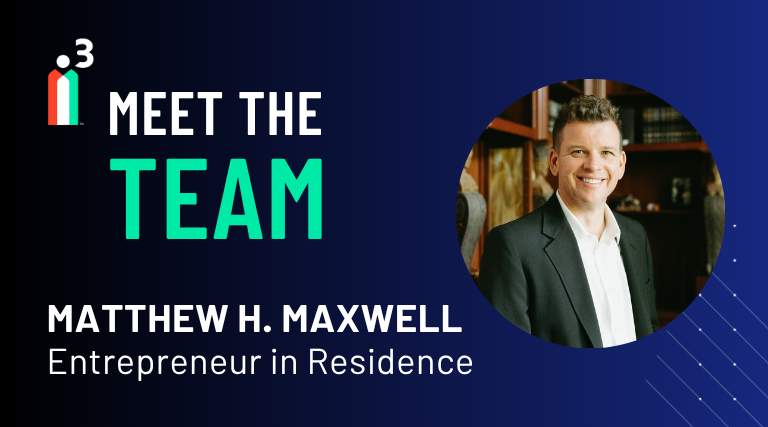
Meet the Team: Matthew H. Maxwell, Entrepreneur in Residence
What drew you to the EIR role at i-Cubed, and how does it align with the rest of your work?
I’m drawn to upstream problems. Most of my work has been downstream, brought in when something’s already broken, when operations are fragmented and trials are underperforming. i-Cubed is different. It’s the moment before the pattern gets set.
That’s where the most durable impact lives: helping innovators build things that don’t recreate the same structural problems I spend the rest of my time solving.
How would you describe your role as an i-Cubed EIR?
Translation. Between what’s theoretically possible and what will actually work in the system as it exists.
Most failures in clinical research innovation aren’t failures of ideas, they’re failures of fit. My job is to close that gap early: stress-test assumptions, pressure-test against real workflows, and help teams build toward something that’s not just fundable but actually deployable.
How do you help innovators at i-Cubed think more like entrepreneurs from day one?
The shift I push for is from “is this a good idea?” to “who changes their behavior for this, and why?” That question is harder than it sounds in clinical research. The system is sticky. Sites have established workflows. Sponsors have entrenched vendor relationships. Investigators have limited bandwidth.
Entrepreneurial thinking here is less about creativity and more about disciplined validation. I get specific with teams:
- Who is the buyer vs. the user—and do their incentives align?
- What’s the current workaround, and is it good enough to kill adoption?
- What would make a site director or study coordinator say yes in a real conversation?
What early questions do you ask to help teams define their path and move from concept to something tangible?
Four questions I come back to every time:
- Who specifically is this for, and what are they doing today instead?
- Where does this land in an existing workflow—does it replace a step, add one, or require a new one?
- What does adoption actually look like on the ground—who has to change, and how much?
- What’s the fastest way to get a real-world signal, not a survey?
If a team can answer those cleanly, the path forward usually clarifies fast.
What’s the most common early misstep you see in startup thinking, and how do you help teams course-correct?
Underestimating system inertia. Clinical research is not a greenfield environment. It’s heavily regulated, resource-constrained, and built on habits and relationships that don’t change easily. I see teams design for how the system should work rather than how it does.
The correction is almost always narrowing: finding the smallest slice of the problem where the solution can prove itself within existing constraints, without requiring anyone to take a leap of faith.
Why is customer discovery especially critical in clinical research, and how do you help innovators get it right?
Because stated preferences and actual adoption behavior are completely different things in this space, especially when you’re talking to people who are overwhelmed and optimistic at the same time.
Discovery in clinical research means understanding incentives, reimbursement structures, workflow realities, and regulatory guardrails, not just asking what would be useful. I push teams to go deeper than executives: talk to coordinators, talk to investigators mid-study, talk to the people whose day actually changes if this works. That’s where the real signal is.
You advise startups both inside and outside of Duke. What’s different about working with academic innovators at DCRI?
The depth is real. Academic innovators at DCRI are solving problems they’ve lived. They’ve seen gaps in patient care and research that most commercial developers don’t have access to.
The work I focus on is translating that clinical insight into something that can operate at scale outside the institution. DCRI’s credibility and data infrastructure are genuine assets. The gap is usually commercialization thinking…not the problem identification, but the solution path.
What has surprised or impressed you most about the teams and ideas coming through i-Cubed?
The level of proximity to real problems. These aren’t abstract ideas because they’re coming from people who have felt the friction firsthand, whether that’s in patient recruitment, protocol execution, or data flow.
What’s impressed me most is when teams are willing to challenge their own assumptions early. The strongest groups aren’t the ones with the most polished ideas, they’re the ones that iterate quickly when reality pushes back. That’s a signal they can actually make the transition from concept to something that works in the field.
How do you see the healthcare/clinical research innovation landscape evolving—and where can academic institutions like Duke have a greater impact?
The infrastructure hasn’t caught up to the ambition. Everyone agrees on the direction, more decentralization, patient-centric, data-driven. But the operational and regulatory scaffolding is lagging.
Academic institutions like Duke are positioned to close that gap in a specific way: not as trial participants, but as architects. That means:
- Leading in real-world evidence and pragmatic trial design
- Building scalable research infrastructure that other organizations can leverage
- Acting as connectors between sponsors, sites, and patients at a systems level
The opportunity is to stop being a destination and start being a platform.
In your experience, how do you build innovation cultures that last?
You build them around execution, not ideas.
Most organizations say they value innovation, but what they actually reward is risk avoidance. Lasting innovation cultures flip that. They make it safe to test, learn, and adjust quickly.
That requires a few things:
- Clear connection between innovation and real operational outcomes
- Access to real environments where ideas can be tested, not just discussed
- Leadership that reinforces learning velocity over being right the first time
The cultures that last are the ones where innovation is part of how work gets done, not a separate activity.
How do you guide teams to think about product-market fit, particularly in the healthcare space?
In healthcare, product-market fit is really workflow fit and incentive fit. Those are the two questions that matter.
Does this slot into existing processes without adding burden? And does it help the organization hit the metrics it’s actually measured on? If the answer to either is no, the adoption story falls apart regardless of how strong the underlying idea is. Value has to be visible fast—time saved, enrollment improved, compliance increased—because the system doesn’t extend much patience to promising but unproven.
What lessons about execution and growth have stayed with you across your work?
Execution is friction removal. That’s the lens I’ve kept across every context. The biggest gains almost never come from adding something new. They come from identifying what’s slowing the system down and eliminating it.
Growth follows when the underlying system works. When it doesn’t, adding more effort or resources usually just amplifies the dysfunction.
What excites you about AI’s potential in this field—and what concerns you?
What excites me is the potential to absorb the manual burden that’s crushing clinical research operations right now: patient identification, outreach, data abstraction, operational decision-making. There’s real leverage there.
What concerns me is the tendency to automate before understanding the workflow. AI tools that don’t account for how sites actually operate, how investigators actually make decisions, how patients actually engage—those tools add noise instead of reducing it. The biggest opportunity is pairing AI capability with strong operational design. One without the other doesn’t hold.
What motivates you to keep doing this kind of work—what excites you about clinical research innovation?
Access. The gap between what’s achievable in clinical research and what patients actually experience is still enormous…in who gets enrolled, where trials run, how long they take. Closing that gap requires better systems, better tools, and better execution. That’s the work. I don’t find it abstract.
Outside of work, what’s something you love to do that recharges or inspires you—whether it’s a book, hobby, etc.?
I spend a lot of time leveraging the capabilities of AI to explore large data sets. I want to understand what non-obvious patterns exist in the ecosystem that we could address. I also do “touch grass” throughout the day, thanks to my trusted assistant: my German Shepherd, Lilly.
What’s a fun fact people may be surprised to learn about you?
I have a German Shepherd named Lilly who keeps me honest on systems thinking. She’s incredibly routine-driven, and if something breaks that pattern, she immediately reacts. It’s a good reminder that well-designed systems should feel intuitive…if they don’t, people (and dogs) will push back.