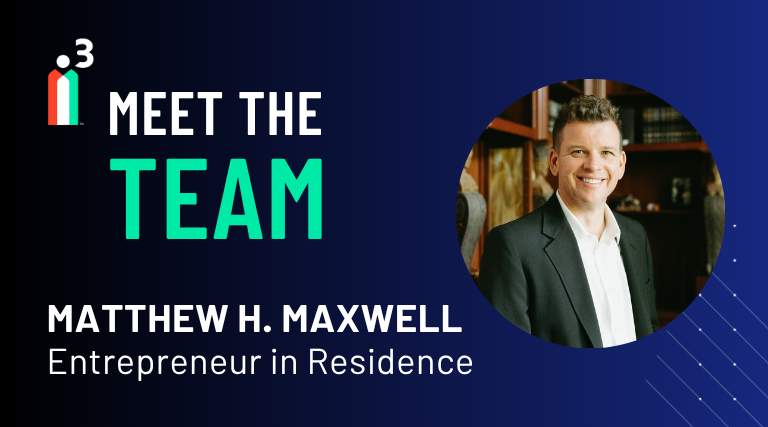
Meet the Team: Matthew H. Maxwell, Entrepreneur in Residence

May 11, 2026

Meet the Team: Matthew H. Maxwell, Entrepreneur in Residence
What drew you to the EIR role at i-Cubed, and how does it align with the rest of your work?

I’m drawn to upstream problems. Most of my work has been downstream, brought in when something’s already broken, when operations are fragmented and trials are underperforming. i-Cubed is different. It’s the moment before the pattern gets set.

That’s where the most durable impact lives: helping innovators build things that don’t recreate the same structural problems I spend the rest of my time solving.

How would you describe your role as an i-Cubed EIR?

Translation. Between what’s theoretically possible and what will actually work in the system as it exists.

Most failures in clinical research innovation aren’t failures of ideas, they’re failures of fit. My job is to close that gap early: stress-test assumptions, pressure-test against real workflows, and help teams build toward something that’s not just fundable but actually deployable.

How do you help innovators at i-Cubed think more like entrepreneurs from day one?

The shift I push for is from “is this a good idea?” to “who changes their behavior for this, and why?” That question is harder than it sounds in clinical research. The system is sticky. Sites have established workflows. Sponsors have entrenched vendor relationships. Investigators have limited bandwidth.

Entrepreneurial thinking here is less about creativity and more about disciplined validation. I get specific with teams:

  • Who is the buyer vs. the user—and do their incentives align?
  • What’s the current workaround, and is it good enough to kill adoption?
  • What would make a site director or study coordinator say yes in a real conversation?

What early questions do you ask to help teams define their path and move from concept to something tangible?

Four questions I come back to every time:

  • Who specifically is this for, and what are they doing today instead?
  • Where does this land in an existing workflow—does it replace a step, add one, or require a new one?
  • What does adoption actually look like on the ground—who has to change, and how much?
  • What’s the fastest way to get a real-world signal, not a survey?

If a team can answer those cleanly, the path forward usually clarifies fast.

What’s the most common early misstep you see in startup thinking, and how do you help teams course-correct?

Underestimating system inertia. Clinical research is not a greenfield environment. It’s heavily regulated, resource-constrained, and built on habits and relationships that don’t change easily. I see teams design for how the system should work rather than how it does.

The correction is almost always narrowing: finding the smallest slice of the problem where the solution can prove itself within existing constraints, without requiring anyone to take a leap of faith.

Why is customer discovery especially critical in clinical research, and how do you help innovators get it right?

Because stated preferences and actual adoption behavior are completely different things in this space, especially when you’re talking to people who are overwhelmed and optimistic at the same time.

Discovery in clinical research means understanding incentives, reimbursement structures, workflow realities, and regulatory guardrails, not just asking what would be useful. I push teams to go deeper than executives: talk to coordinators, talk to investigators mid-study, talk to the people whose day actually changes if this works. That’s where the real signal is.

You advise startups both inside and outside of Duke. What’s different about working with academic innovators at DCRI?

The depth is real. Academic innovators at DCRI are solving problems they’ve lived. They’ve seen gaps in patient care and research that most commercial developers don’t have access to.

The work I focus on is translating that clinical insight into something that can operate at scale outside the institution. DCRI’s credibility and data infrastructure are genuine assets. The gap is usually commercialization thinking…not the problem identification, but the solution path.

What has surprised or impressed you most about the teams and ideas coming through i-Cubed?

The level of proximity to real problems. These aren’t abstract ideas because they’re coming from people who have felt the friction firsthand, whether that’s in patient recruitment, protocol execution, or data flow.

What’s impressed me most is when teams are willing to challenge their own assumptions early. The strongest groups aren’t the ones with the most polished ideas, they’re the ones that iterate quickly when reality pushes back. That’s a signal they can actually make the transition from concept to something that works in the field.

How do you see the healthcare/clinical research innovation landscape evolving—and where can academic institutions like Duke have a greater impact?

The infrastructure hasn’t caught up to the ambition. Everyone agrees on the direction, more decentralization, patient-centric, data-driven. But the operational and regulatory scaffolding is lagging.

Academic institutions like Duke are positioned to close that gap in a specific way: not as trial participants, but as architects. That means:

  • Leading in real-world evidence and pragmatic trial design
  • Building scalable research infrastructure that other organizations can leverage
  • Acting as connectors between sponsors, sites, and patients at a systems level

The opportunity is to stop being a destination and start being a platform.

In your experience, how do you build innovation cultures that last?

You build them around execution, not ideas.

Most organizations say they value innovation, but what they actually reward is risk avoidance. Lasting innovation cultures flip that. They make it safe to test, learn, and adjust quickly.

That requires a few things:

  • Clear connection between innovation and real operational outcomes
  • Access to real environments where ideas can be tested, not just discussed
  • Leadership that reinforces learning velocity over being right the first time

The cultures that last are the ones where innovation is part of how work gets done, not a separate activity.

How do you guide teams to think about product-market fit, particularly in the healthcare space?

In healthcare, product-market fit is really workflow fit and incentive fit. Those are the two questions that matter.

Does this slot into existing processes without adding burden? And does it help the organization hit the metrics it’s actually measured on? If the answer to either is no, the adoption story falls apart regardless of how strong the underlying idea is. Value has to be visible fast—time saved, enrollment improved, compliance increased—because the system doesn’t extend much patience to promising but unproven.

What lessons about execution and growth have stayed with you across your work?

Execution is friction removal. That’s the lens I’ve kept across every context. The biggest gains almost never come from adding something new. They come from identifying what’s slowing the system down and eliminating it.

Growth follows when the underlying system works. When it doesn’t, adding more effort or resources usually just amplifies the dysfunction.

What excites you about AI’s potential in this field—and what concerns you?

What excites me is the potential to absorb the manual burden that’s crushing clinical research operations right now: patient identification, outreach, data abstraction, operational decision-making. There’s real leverage there.

What concerns me is the tendency to automate before understanding the workflow. AI tools that don’t account for how sites actually operate, how investigators actually make decisions, how patients actually engage—those tools add noise instead of reducing it. The biggest opportunity is pairing AI capability with strong operational design. One without the other doesn’t hold.

What motivates you to keep doing this kind of work—what excites you about clinical research innovation?

Access. The gap between what’s achievable in clinical research and what patients actually experience is still enormous…in who gets enrolled, where trials run, how long they take. Closing that gap requires better systems, better tools, and better execution. That’s the work. I don’t find it abstract.

Outside of work, what’s something you love to do that recharges or inspires you—whether it’s a book, hobby, etc.?

I spend a lot of time leveraging the capabilities of AI to explore large data sets. I want to understand what non-obvious patterns exist in the ecosystem that we could address. I also do “touch grass” throughout the day, thanks to my trusted assistant: my German Shepherd, Lilly.

What’s a fun fact people may be surprised to learn about you?

I have a German Shepherd named Lilly who keeps me honest on systems thinking. She’s incredibly routine-driven, and if something breaks that pattern, she immediately reacts. It’s a good reminder that well-designed systems should feel intuitive…if they don’t, people (and dogs) will push back.


i-Cubed Innovation Spotlight Highlights Project Loom’s Vision for the Future of Clinical Trial Operations

May 7, 2026

i-Cubed Innovation Spotlight Highlights Project Loom’s Vision for the Future of Clinical Trial Operations

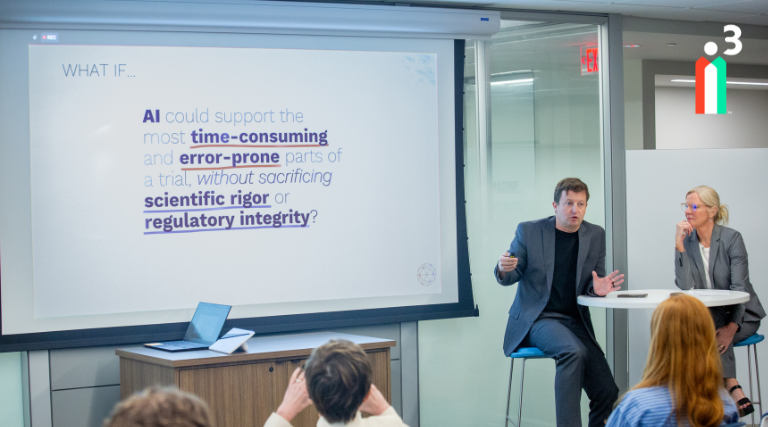
At its latest Innovation Spotlight event, i-Cubed brought together researchers, innovators, and clinical trial professionals for an immersive and engaging look at Project Loom, one of i-Cubed’s flagship R&D initiatives exploring how the integration of agentic AI is accelerating end-to-end clinical trial operations.

The event featured a demonstration of Loom’s evolving platform capabilities and a broader discussion of how AI-driven orchestration could fundamentally reshape trial design, execution, and scale, moving beyond today’s fragmented systems toward a more connected, intelligent future.

Exploring What’s Possible Beyond Traditional Trial Infrastructure 

Rather than focusing narrowly on a single tool or workflow, Project Loom is a bold rethink of the infrastructure behind clinical trials. Rather than optimizing isolated workflows, Project Loom connects the entire operational ecosystem. The Project Loom team showcased how AI-supported workflows unify, streamline, and connect multiple aspects of trial operations, from protocol and study documentation to participant-facing processes and broader executional coordination, all while maintaining an emphasis on quality, compliance, and scientific rigor.
Audience response reflected both curiosity and enthusiasm. Questions during the session focused on deeper scientific validation, including requests for supporting publications and additional resources, signaling strong interest in the research foundation behind the initiative. Participants also responded positively to the potential implications for decentralized clinical trials (DCTs) and operational scalability.
One attendee noted they were “very intrigued by the endless efficiencies that can support DCT trials moving forward,” reinforcing a central theme of the event: Project Loom’s promise lies not only in innovation, but in practical applications that could improve how trials are designed and delivered.

Spotlighting Innovation with Real-World Potential 

As with previous Innovation Spotlight events, i-Cubed’s goal was not simply to introduce new technology, but to spark thoughtful dialogue around solutions that could meaningfully reshape clinical research.

Project Loom exemplified that approach by igniting conversation around how AI may eventually support faster, more connected, and more participant-centered trial ecosystems.

For i-Cubed, the event was another milestone in its mission to bring together emerging technologies, strategic collaborators, and the broader research community to explore what’s next for clinical trial innovation.

Stay tuned for more Innovation Spotlight events this Fall as i-Cubed continues showcasing bold ideas, breakthrough technologies, and the innovators working to transform research.

To learn more about Project Loom, visit: projectloom.org 

About i-Cubed   
i-Cubed™ is the center for clinical research innovation, powered by the unique expertise and resources of the Duke Clinical Research Institute. i-Cubed supports individuals, teams, and organizations in turning their ideas into tools, technologies, and processes that transform how clinical research is done — for the benefit of people everywhere.  

SPARK Grant Supports i-Cubed Vision for AI-Driven, End-to-End Clinical Trials

March 25, 2026

SPARK Grant Supports i-Cubed Vision for AI-Driven, End-to-End Clinical Trials

What if agentic AI could provide end-to-end support for clinical trial execution? i-Cubed is one step further to realizing this dream so that clinical teams can apply their expertise where it matters most. 

A multi-disciplinary team, supported by i-Cubed and led by Principal Investigator Christoph Hornik, MD, PhD, has been awarded a Duke Science & Technology (DST) SPARK Seed Grant for their proposal to leverage AI to accelerate clinical trials.

Project Loom, one of i-Cubed’s flagship R&D initiatives, was designed to answer the question: Can AI support the most time-consuming and error-prone parts of running a clinical trial without sacrificing scientific rigor or regulatory integrity?

Project Loom is revolutionary and designed to thoughtfully integrate AI into clinical trial implementation in a way that strengthens, not replaces, human expertise. Clinicians, trialists, and operations leaders define trial intent, interpret protocols, and make the value-driven decisions that safeguard scientific validity, regulatory compliance, and, most importantly, patient safety. AI supports this work by taking on repetitive, time-intensive operational tasks, such as streamlining documentation, routing information, and standardizing processes, so teams can focus their energy where human judgment is essential. By reducing operational friction and freeing experts to identify risks early, manage complex relationships, and make nuanced decisions, Project Loom aims to accelerate the delivery of new therapies while preserving the rigor, compassion, and oversight that high-quality clinical research demands.

i-Cubed’s proposal was one of more than 130 submissions reviewed by the Office for Research & Innovation’s DST SPARK Seed Grant Selection Committee. Reviewers praised the project’s clarity, feasibility, and potential for broad impact, noting that it offers a promising opportunity for Duke to establish leadership in this important and rapidly evolving space. The award was facilitated through Duke's Office for Research and Innovation and the Office of the Provost and was funded through a combination of the Duke Discovery funding supporting science and technology and internal Duke funding.

“Clinical trials are the engine of medical progress, but they are still built on slow, manual, and fragmented processes,” said Hornik. “This project shows that AI can be harnessed responsibly to modernize that engine – and we’re just getting started.”

At i-Cubed, the Duke Clinical Research Institute’s center for clinical research innovation, this project is part of a growing portfolio of initiatives focused on improving the speed, cost, efficiency, and impact of clinical research. The project reflects the center’s mission to develop sustainable solutions that make clinical research seamless and impactful for everyone.

To learn more about Project Loom, visit: Projectloom.org 

About i-Cubed   
i-Cubed™ is the center for clinical research innovation, powered by the unique expertise and resources of the Duke Clinical Research Institute. i-Cubed supports individuals, teams, and organizations in turning their ideas into tools, technologies, and processes that transform how clinical research is done — for the benefit of people everywhere.  
 
About Areti Health  
Areti Health is a venture-backed Silicon Valley AI technology company transforming how clinical research identifies, engages, and advances patients through trials. Its core innovation is an AI-driven Coordinator that is the only full-service trial automation AI agent performing medical record matching, 24/7 patient interaction, scanning clinical data, engaging candidates across voice and text channels, pre-qualifying prospects, scheduling next steps, performing consents, collecting ePROs, and nurturing participation with empathetic, intelligent responses. Areti’s conversational, generative, and agentic AI Coordinator capabilities integrates into with EMRs, CRMs, and clinical systems and workflows to accelerate recruitment, reduce screen failure rates, manual burden, and improve operational predictability by eliminating routine manual work. Learn more at [www.aretihealth.com].  
 
About Health Universe 
Health Universe is clinical AI infrastructure that enables healthcare organizations to deploy AI-powered workflows for clinical operations, research, and care delivery. The platform's multi-agent orchestration technology automates complex clinical processes from trial document preparation and patient identification to oncology summarization while maintaining regulatory compliance and quality standards. Health Universe serves EHR vendors, hospitals, payers, and life sciences organizations, with partnerships including academic medical centers and oncology care networks. Through its Navigator clinical AI companion and workflow automation capabilities, Health Universe helps free clinicians and researchers from administrative burden so they can focus on advancing patient care. Learn more at [www.healthuniverse.com].  
 
About Maxis AI 
Maxis AI is pioneering the future of clinical development with its Agentic AI platform, creating a hybrid, human-AI workforce, where intelligent AI agents and augmented human experts collaborate to conquer complexity. We empower life sciences organizations to move beyond the linear model of rising costs and timelines, enabling them to orchestrate trials with unprecedented speed, precision, and trust. Built upon the foundation of 3300 plus clinical trials’ execution experience and domain context, our enterprise-ready Agentic AI platform is "Designed to Think. Built to Act.,". It automates and optimizes end-to-end workflows, from study start up to regulatory submissions. We provide a fully governed, compliant, and integrated ecosystem that transforms human intent into intelligent action, delivering measurable results and accelerating the entire drug development lifecycle. Our mission is to transform the operating model of clinical research, ensuring that the most innovative therapies reach patients faster. Maxis AI serves pharma, biotech, medical devices, and CROs of all sizes, with partnerships including academic medical centers and site networks. [www.maxisai.com]. 

Meet the Team: Jeff Lee, Entrepreneur in Residence

March 17, 2026

Meet the Team: Jeff Lee, Entrepreneur in Residence

What drew you to the Entrepreneur in Residence (EIR) role at i-Cubed?

I’ve collaborated with DCRI/CTTI in the past and have been consistently impressed with the caliber of the staff and leadership. Helping to guide and shape early-stage concepts allows me to leverage learnings from my prior startup experience and stay engaged with dynamic founders.

How would you describe your role as an EIR?

Helping teams evaluate nascent product concepts by incorporating customer and user perspectives; guiding founding teams through initial go-to-market approaches.

What early questions do you ask to help teams define their path and move from concept to something tangible?

Does the functionality we want to build constitute a new company, or is it more realistically a feature of someone else’s existing product?

Why is “right now” (as opposed to last year or next year) THE opportune time for this new product (i.e., what is the disruptive event that makes this a uniquely perfect time to build this)?

What is your “right to win” or unfair advantage that makes you the right founder to bring this product to life?

What’s the most common early misstep you see in startup thinking, and how do you help teams course-correct?

Founders tend to over-index on optimism. They’re often ‘dreamers,’ and this quality gives them the motivation to persevere in the challenging startup journey. Often, I find that this bias for optimism creates a tendency to pay more attention to the positive feedback on their ideas and turn a blind eye to the negative signals and competitive threats.

How do you guide teams to think about product-market fit, particularly in the healthcare space?

I highly recommend having as narrow an MVP (minimal viable product) as possible. This allows you to get into the market quickly, develop trust with customers, and use the early deployments to gain insights that will allow you to refine the product to be even more differentiated and aligned with customer needs. Founders are often tempted to ‘boil the ocean’ and spend more time building product than they do listening to customers. I believe that for every startup that nailed product market fit using the first generation of their product, there are dozens of companies that succeeded through refining their product gradually over time, steadily making themselves indispensable to their customers.

What lessons about execution and growth have stayed with you across your work?

I’ve generally been involved with ‘lightly capitalized’ or outright bootstrapped businesses. I believe in running lean and building responsibly based on actual customer revenue (rather than VC funds).  I believe that customer trust is an undervalued ‘moat’ against competition. Building a great team of people who take care of the customer (and each other) can result in long-term, mutually beneficial relationships that do more to keep you ahead of competitors than anything else.

What excites you about AI’s potential in this field - and what concerns you?

Clearly, AI creates endless opportunities to transform clinical trial conduct. That said, it’s much harder to grow a successful start-up in the era of ‘vibe-coding’ and rapid software development. Once you identify an unserved need, it’s quite likely that multiple other startups and incumbents are going to develop the same functionality that you’re working on. While I prefer bootstrapped or lightly capitalized businesses, getting funded properly at an early stage may be a critical determinant of success.

What’s a fun fact people may be surprised to learn about you?

Before getting into the startup world, I worked for a time at Mars Inc., at the plant where M&Ms are made.  A (not so) fun fact is that, on humid days, freshly-made chocolate smells almost exactly like vomit.

i-Cubed Demonstrates AI-Driven Clinical Trial Automation in Major Proof-of-Concept Study

February 2, 2026

i-Cubed Demonstrates AI-Driven Clinical Trial Automation in Major Proof-of-Concept Study

i-Cubed, the center for clinical research innovation at the Duke Clinical Research Institute (DCRI), has reached a major milestone in its effort to reimagine how clinical trials are run, completing a successful proof-of-concept study that demonstrates how AI can automate large portions of clinical trial operations faster, more consistently, and with built-in quality and compliance controls.

Project Loom, one of i-Cubed’s flagship R&D initiatives, was designed to answer the question: Can AI take on the most time-consuming and error-prone parts of running a clinical trial without sacrificing scientific rigor or regulatory integrity?

To explore that question, i-Cubed collaborated with technology partners Health Universe, Maxis AI, and Areti Health, combining each partner’s AI capabilities with DCRI’s deep expertise in trial design, regulatory requirements, and clinical operations. Working in parallel, the teams developed AI-enabled workflows capable of supporting key trial activities within a few weeks.

Those agentic workflows were then evaluated in a rigorous proof-of-concept study using a simulated version of a previously completed clinical trial. Each system was asked to perform a wide variety of clinical trial functions, including generating study documents, preparing and making IRB submissions, screening and enrolling virtual participants, capturing patient-reported outcomes, building electronic case report forms and data capture systems, extracting data from synthetic electronic health records, and producing a clinical study report. Performance was evaluated on time to completion, output quality, accuracy, and user experience. Final, cross-platform analyses are still underway, but the systems successfully executed the full end-to-end trial workflow.

“What made this project unique was that we weren’t just proving AI could generate content — we were proving it could serve as a central platform, orchestrating multiple AI agents that execute coordinated trial operations inside a real-world regulatory and scientific framework,” said Health Universe CEO Dan Caron.

“Working alongside DCRI and i-Cubed, we were able to show that complexity across data and workflows is not only manageable, but solvable with a speed and reliability that can transform the economics of clinical trials,” Maxis AI CEO Moulik Shah added.

From the participant lead sourcing and engagement perspective, Paul Neyman, Areti Health Co-Founder, said, “Participant engagement is one of the hardest parts of running a trial. This project showed how AI autonomously orchestrates the entire enrollment journey — medical chart matching, participant education, scheduling, consent, ePRO, etc. — meeting participants across text, voice, and web. What this unlocks is dramatically faster enrollment, more consistent, human-centered experiences, higher data quality, and clinical teams who can finally focus on patients instead of logistics.”

“Clinical trials are the engine of medical progress, but they are still built on slow, manual, and fragmented processes,” said principal investigator Christoph Hornik, MD, MPH. “This project shows that AI can be harnessed responsibly to modernize that engine — and we’re just getting started.”

For i-Cubed, Project Loom exemplifies its mission: to leverage the unique expertise and resources of the DCRI and turn ideas into tools, technologies, and processes that transform how clinical research is done — for the benefit of people everywhere.

To learn more about Project Loom, visit: Projectloom.org

About i-Cubed  

i-Cubed™ is the center for clinical research innovation, powered by the unique expertise and resources of the Duke Clinical Research Institute. i-Cubed supports individuals, teams, and organizations in turning their ideas into tools, technologies, and processes that transform how clinical research is done — for the benefit of people everywhere. 

About Areti Health 

Areti Health is a venture-backed Silicon Valley AI technology company transforming how clinical research identifies, engages, and advances patients through trials. Its core innovation is an AI-driven Coordinator that is the only full-service trial automation AI agent performing medical record matching, 24/7 patient interaction, scanning clinical data, engaging candidates across voice and text channels, pre-qualifying prospects, scheduling next steps, performing consents, collecting ePROs, and nurturing participation with empathetic, intelligent responses. Areti’s conversational, generative, and agentic AI Coordinator capabilities integrates into with EMRs, CRMs, and clinical systems and workflows to accelerate recruitment, reduce screen failure rates, manual burden, and improve operational predictability by eliminating routine manual work. Learn more at [www.aretihealth.com]. 
 
About Health Universe

Health Universe is clinical AI infrastructure that enables healthcare organizations to deploy AI-powered workflows for clinical operations, research, and care delivery. The platform's multi-agent orchestration technology automates complex clinical processes from trial document preparation and patient identification to oncology summarization while maintaining regulatory compliance and quality standards. Health Universe serves EHR vendors, hospitals, payers, and life sciences organizations, with partnerships including academic medical centers and oncology care networks. Through its Navigator clinical AI companion and workflow automation capabilities, Health Universe helps free clinicians and researchers from administrative burden so they can focus on advancing patient care. Learn more at [www.healthuniverse.com]. 

About Maxis AI

Maxis AI is pioneering the future of clinical development with its Agentic AI platform, creating a hybrid, human-AI workforce, where intelligent AI agents and augmented human experts collaborate to conquer complexity. We empower life sciences organizations to move beyond the linear model of rising costs and timelines, enabling them to orchestrate trials with unprecedented speed, precision, and trust. Built upon the foundation of 3300 plus clinical trials’ execution experience and domain context, our enterprise-ready Agentic AI platform is "Designed to Think. Built to Act.,". It automates and optimizes end-to-end workflows, from study start up to regulatory submissions. We provide a fully governed, compliant, and integrated ecosystem that transforms human intent into intelligent action, delivering measurable results and accelerating the entire drug development lifecycle. Our mission is to transform the operating model of clinical research, ensuring that the most innovative therapies reach patients faster. Maxis AI serves pharma, biotech, medical devices, and CROs of all sizes, with partnerships including academic medical centers and site networks. [www.maxisai.com]. 

Meet the Team: Tom Collopy, Entrepreneur in Residence

November 20, 2025

Meet the Team: Tom Collopy, Entrepreneur in Residence

What brought you to the Entrepreneur in Residence (EIR) role at i-Cubed?

I was introduced to i-Cubed through Donna Parker, though I wasn’t sure why at first. We met at an event where I was speaking to founders and innovators in the startup space. It turns out my experience aligned with what she thought could be valuable to i-Cubed.

You can probably tell from my gray hairs that I’ve been through a lot as an innovator, sometimes succeeding, but often learning through failure. That’s what I bring to i-Cubed: experience gained the hard way.

When I left corporate life, I wanted to help founders avoid the mistakes that come with inexperience. I believed I had something useful to offer. I didn’t get it right at first, but I’ve spent the past nine years trying to do just that.

I work best with founders who approach things with an open mind, who are willing to listen, reflect, and decide what's right for them. Donna approached me that way, and when I met Mickey, he was the same. That openness made me think, "I’m going to learn a lot here, and maybe they’ll consider what I have to offer." That’s what drew me in.

How would you define your role as an EIR?

At a high level, it means bringing experience to the table and using it to support others. What I’ve come to understand at i-Cubed, is that the leadership team genuinely values diverse voices in the room to help make better decisions. So, I see myself as a voice of experience, whether I’m working directly with an innovator or with the i-Cubed leadership team. My role is to bring in ideas that come from having lived through the startup process and offer them for others to consider.

What’s the most common early misstep you see in startups, and how do you help teams course-correct?

One of the biggest early challenges I see is the tension between a founder’s belief in their solution and what customers actually want.

Most founders believe that if they solve a problem, people will naturally want to buy the solution, but that’s not always true. The real challenge isn’t building the solution, it’s learning how to sell it. Startups usually fail, not because they couldn’t build something useful, but because they couldn’t get others to see its value.

Founders often lead with, “Here’s the problem, and here’s my solution with all these great features,” but customers don’t think that way. They have to feel the problem is worth solving, and that your solution is the right fit for them. That emotional connection is critical.

The biggest shift I try to help founders make is going from being builders to being sellers. And then I help them learn how to actually sell. That’s been the most consistent challenge I’ve seen over the past nine years.

Can you tell me more about your work outside of i-Cubed and your background in startups?

People often ask me what I do day-to-day, sometimes in the presence of my wife. She usually laughs and says I’m retired. But the truth is, everything I do centers on solving complex problems. That’s what my brain loves.

I teach two entrepreneurship classes at the University of North Carolina at Chapel Hill. One focuses on building a startup from scratch, and the other teaches how to build a sales funnel. That second course involves student founders with real startups, which gives me a great lab to keep learning what works and what doesn’t.

I also guest lecture at North Carolina State University, mostly on using AI in the startup space. I run three different sessions there, which I especially enjoy because I don’t have to grade anything!

I volunteer with accelerators like NC IDEA, a nonprofit in North Carolina that offers grants and runs startup programs. I usually come in to talk about customer discovery, which is really about figuring out how to sell.

Lastly, I’m a partner in an AI consulting company. We help businesses figure out where AI fits and how to use it more effectively. Again, it’s all about solving complex problems and helping others do the same.

Across all these roles, I’m teaching and learning. I even wrote a book on using AI to build a startup and created 33 guides on applying AI in that context. Writing is another way I teach and figure out what I actually understand!

So the simple answer is: I try to help people. I just do it in a lot of different ways.

What’s your perspective on AI’s role in innovation?

AI is on everyone’s mind right now. For me, what’s exciting is how AI transforms learning and advising. I first saw this as a teacher; when you’re in front of a classroom and you see students disengaged, you realize the old model of “I teach, you absorb” doesn’t quite work anymore. But when AI entered the picture a few years ago, everything shifted. I saw the potential for students to use AI as both an educational tool and an advisor.

If I provide the right context, AI can quickly surface what’s most important and even guide me through the next steps. That’s how the guides in my book are structured; students use prompts not just to learn, but to figure out how to do something. Teaching today is really about helping people communicate more clearly and ask better questions. If you don’t give AI enough context, it might hallucinate. That’s not a problem with the tool; it’s a signal that you need to be more specific.

As someone who’s not a natural writer, I find AI incredibly freeing. A guide that once took me three or four days to write now takes an hour. I can share what I know with the world much faster.

That said, there are concerns. One of the biggest concerns I hear in consulting is the fear of job loss. But I believe AI won’t take away jobs as much as it will change how we do them. It’s a powerful assistant, not a human replacement. AI can offer options, but humans still need to judge what’s right. And the quality of the output depends entirely on the quality of the prompt, which comes from human expertise.

I’m not particularly worried about data sharing or copyright with AI. Every generation faces new technology, PCs, the internet, smartphones, and we adapt. I view AI in much the same way: a tool that rewards those who learn how to use it responsibly and effectively.

What has surprised you most about working with i-Cubed?

Coming into i-Cubed, I didn’t know much about clinical research, but what immediately struck me was the mindset of the leadership. They are deeply committed to helping innovators bring ideas into the world that can make a real difference. That commitment shows up in their decisions and in the culture they’ve built. It’s not just talk – they’re all in.

Another thing that impressed me is how busy and accomplished the team is, and yet they’re passionate and fully engaged. They don’t do this work for recognition or money, it’s about impact. They genuinely want to help innovators succeed, and that’s rare.

The ideas themselves are impressive, too. I’ve advised startups for nearly a decade and seen hundreds of concepts. The ones I see at i-Cubed have the potential to improve lives, whether that means helping people live longer, live healthier, or just have a better day-to-day experience. The best innovators are those who stay open to letting their ideas evolve. At i-Cubed, I see that openness all the time.

How do you help teams define their path and move from concept to something tangible?

A lot of innovators start with a vision and a set of beliefs. Early on, they reach a fork in the road. One path is: “I know the answer, I just need to execute.” The other is: “Let me test what I believe and find out what’s really true.”

Those who follow the first path often end up burned out, frustrated, and stuck in what I call the “coffee shop conversation” where they’re ready to quit. The second path, the one grounded in curiosity and customer discovery, is harder but leads to better outcomes. It’s not about getting people to love your idea, it’s about discovering what people need, and being willing to adapt your solution accordingly.

In your opinion, how do you build innovation cultures that last?

In big organizations, innovation can be tough. There’s bureaucracy, risk aversion, and a tendency to stick with what works. I spent 33 years in large corporations and got lucky. I found myself in two pockets of real innovation at IBM and Qualcomm. I’ve always had a bias toward fixing problems, trying new things, and making my job easier. But not everyone has that freedom.

That’s where i-Cubed comes in. It creates a safe place within a larger system where it’s okay to think differently. It encourages people to imagine, test, and refine new ideas without fear. That alone makes a huge difference. Combine that with tools like AI, and now you’ve got something powerful. Large language models can help you identify potential users, understand problems, and evaluate ideas, all without judgment.

At its core, i-Cubed gives people permission to explore ideas in a structure that supports and protects innovation. That’s exactly what I had at IBM and Qualcomm. When that structure exists, innovation flourishes.

Outside of work, what’s something you love to do that recharges or inspires you?

People who know me know I spend a lot of time using ChatGPT. I’m a problem solver at heart, and prompting is my creative outlet. But I also know my brain needs downtime. I need space to just think, to let ideas settle, to recharge, and to step away from the constant buzz. That quiet space is where the next big idea usually shows up.

First, I love hitting golf balls. Golf is a hard problem to solve; there’s always something to tweak, improve, or rethink. It keeps my brain engaged in a different way.

Second, I love being on the water. A lot of people don’t know this, but I have five different human-powered watercrafts. I’m lucky to live on a lake, and getting out there with no devices, no distractions, just movement and water, is incredibly calming for me. That’s my reset button.

What’s a fun fact people may be surprised to learn about you?

Well, if you were standing here with me, you’d notice I’m not very tall. So, when I tell people I used to run hurdles, they’re usually surprised.

In high school, I ran cross country in the fall, but I didn’t like running in circles on a track. I wanted something different, and despite hurdles being designed for tall people, I was stubborn enough to stick with it. I went from being pretty bad to being pretty decent. It’s a good reminder that sometimes, what doesn’t “fit” at first can still work if you’re determined enough.

Do you have any advice for potential innovators?

If you’re a founder or innovator, especially someone new to this space, it’s normal to feel fear – fear of putting your idea out there, fear of not knowing what you’re doing, fear of failure or rejection. And when you have a full-time job, a family, a busy life, it’s easy to ask, “Why take the risk?”

I think something’s missing in me because I don’t have that fear, but I know many do. That’s why i-Cubed exists. It’s a place built to help you push past that hesitation. Whether you’re working with me as an EIR or with the leadership team, we’re here to help you fill in the gaps, take smart steps, and see how far your idea can go.

So, if you're on the fence, tamp down the fear, and just ask!

i-Cubed Innovation Spotlight Celebrates Luminate Insights Launch

November 18, 2025

i-Cubed Innovation Spotlight Celebrates Luminate Insights Launch

At the most recent Innovation Spotlight, i-Cubed celebrated the launch of Luminate Insights, a clinical research education and training provider founded by longtime Duke faculty Hayden Bosworth, PhD, and Steven Grambow, PhD, and supported by the Duke Clinical Research Institute.

The digital event was hosted by i-Cubed Operations Director, Donna Parker, MPH, and brought together attendees from across the Duke community for a candid, engaging look at how two career educators transformed an idea that they sketched out over coffee into a startup that delivers customized, expert-led education programs in clinical research, data science, and implementation.

The co-founders reflected on their 25-plus years of collaboration – from the hallways of the Durham VA to leading programs in population health and biostatistics. They shared how recurring challenges such as slow contracting, duplicative content creation, and fragmented workforce training sparked the idea for a new kind of learning company.

Bosworth and Grambow shared the story behind their innovation, demonstrating how Luminate Insights delivers evidence-based, customizable training for clinical researchers, bridging the gap between traditional academic education and the needs of healthcare organizations, research sponsors, and biopharma partners. “Academia moves at the speed of a glacier,” Bosworth said, “but industry needs responsive, ready-to-use solutions.”

With content designed and led by Duke experts, the startup aims to make advanced research education faster, smarter, and more adaptable to emerging technologies that have not been consistently integrated into traditional training programs. Grambow noted, “Research is constantly evolving. People begin with a solid foundation, but they need ways to keep their skills sharp and stay current. Luminate gives them that path.”

The Spotlight also explored their experience partnering with i-Cubed. From refining their value proposition to navigating contracting, project management, and operational logistics, i-Cubed provided embedded support that allowed the founders to focus on innovation rather than administrative hurdles.
Looking ahead, Luminate Insights plans to partner with Duke faculty to expand its training offerings. To learn more and explore how to get involved in upcoming educational programs and applied learning opportunities, visit the Luminate Insights website.

i-Cubed’s Innovation Spotlight series highlights innovators across Duke who are transforming ideas into real-world solutions. Each session offers the Duke research community an inside look at how new startups, tools, and technologies are accelerating clinical research.


About i-Cubed 

i-Cubed™ is the center for clinical research innovation, powered by the unique expertise and resources of the Duke Clinical Research Institute. i-Cubed supports individuals, teams, and organizations in turning their ideas into tools, technologies, and processes that transform how clinical research is done — for the benefit of people everywhere.  

Learn how you can work with i-Cubed to move your ideas forward – get in touch at icubedcenter@duke.edu.  

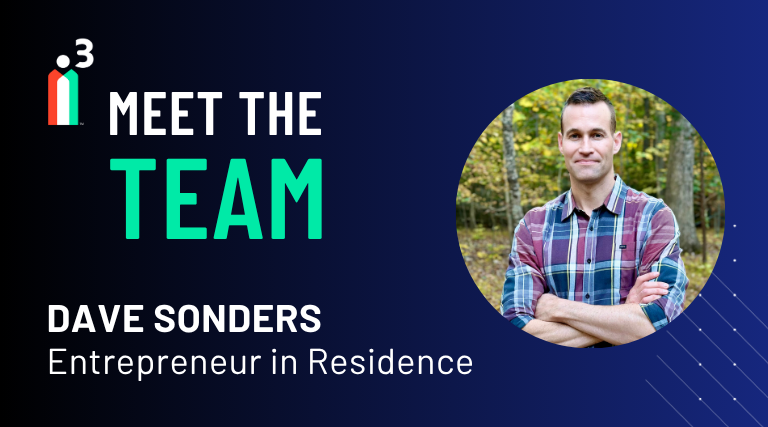
Meet the Team: Dave Sonders, Entrepreneur in Residence

August 27, 2025

Meet the Team: Dave Sonders, Entrepreneur in Residence

What drew you to the Entrepreneur in Residence (EIR) role at i-Cubed?

What drew me to the EIR role was really the people involved. From the very first meeting, when I met Donna and Micky, I was struck by how amazing they were. They're a rare combination – very accomplished, really smart, and also incredibly open-minded and collaborative. That combination is hard to find. They're operating at the top of their game, but they're also curious and open to different ways of working, and to points of view that don’t necessarily align with their own.

That was really interesting to me because I’d never worked in research before. I’ve worked across many product categories, launched products, businesses, and brands, so I had things I could bring to the table, but I knew I’d need to come up to speed in this world.

What attracted me most was the culture of the team, their openness to new ways of thinking, and the access to this storehouse of expertise, IP and capabilities that DCRI has developed over many years. In many ways, those assets are just bottled up, waiting to be unleashed in the form of new businesses and new products.

How would you describe your role as an i-Cubed EIR, and how does it align with the rest of your work?

My role as the EIR is interesting, it's not exactly what I thought it would be coming in. I’d say my role is, first and foremost, to represent the point of view of the business opportunity. There’s a lot of cool stuff that DCRI and i-Cubed could do, but the real focus needs to be: what’s the actual problem we’re trying to solve? Is it a worthwhile problem? Do we have a unique angle? And why should DCRI be the one to solve it?

Those might sound like obvious questions, but in the world of innovation and new ideas, they’re easy to overlook. Everything’s exciting, especially now, when tools like AI can make almost anything better, faster, cheaper. It’s easy to get caught up in that. But my job is to bring teams back to the fundamentals: Is this a problem worth solving? Is it motivating enough that someone would actually change their behavior, change their workflow, make a new purchase, or work in a different way?

That’s the first hurdle. The second is: can we solve this problem in a way that’s unique? What does DCRI bring that gives us a true advantage? Because there are a lot of companies chasing the same opportunities, so what gives us the right to win?

Those are the questions I try to keep front and center, to help guide the team in a more entrepreneurial direction.

How do you help innovators at i-Cubed think more like entrepreneurs from day one?

One way I try to model the entrepreneurial mindset and help the team think more like entrepreneurs is by always asking: what can we do to advance this idea today? We don’t need to have all the answers, we just need to make forward progress.

A lot of entrepreneurship is simply hustle. It’s not about having the shiniest product or the biggest network. It’s about grinding through the hard stuff that others might avoid. Sometimes, it’s just about showing up and putting yourself in a position where, even if you don’t have it all figured out, you try something, run an experiment, test a hypothesis, and learn from it.

If we can learn something every day or every week, we can turn those learning cycles into real progress. And the faster you can go through those cycles, the better. If you can learn faster than others chasing the same opportunity, you’re going to win.

What is something you look for to determine if a new idea has real potential?

When I’m evaluating a new idea—whether it’s mine or someone else’s—one of the first things I look for is whether the people who have that problem are actively searching for a better solution. That’s a strong sign there’s real potential.

If they just say, “Yeah, this sucks, but it’s the way it is,” or they’ve come up with their own workaround, that’s less encouraging. But if they’re actually trying new things, and you show them a sketch, a prototype, or even just describe the idea—and they lean in and say things like, “I’d use that,” or “Can I try it?”—that kind of interest and willingness to act is a really good sign.

What is the most common early misstep you see in startup thinking and how do you help teams course correct?

There are countless ways for startups to fail, I've seen them, and I've made many of those mistakes myself. But one of the most common early missteps I see is jumping into a well-known problem without a clear, unique angle. At i-Cubed, many of the challenges we’re working on, like recruitment in clinical trials, are widely acknowledged across the industry. They’re important, persistent problems that plenty of people have already tried to solve.

Take, for example, PreMatch, an i-Cubed solution I’m supporting that focuses on prescreening and recruitment. Everyone in clinical research knows recruitment is slow, expensive, and a major cause of trial delays. But because it's such a familiar problem, the bar is high, if we can’t articulate why our approach is different or what specific advantage we bring to the table, then we probably shouldn’t pursue it. It’s not enough to have a solution. You need a unique insight or edge that either resonates with your target users or gives you a functional advantage you can prove with real results. Helping teams find and sharpen that angle is a big part of how I support them.

Why is customer discovery especially critical in clinical research, and how do you help innovators get it right?

Customer discovery is important in every market. When I say customer discovery, I mean really just learning about the people in the world adjacent to the problem and understanding their whole context, not just their workflow, demographic profile, or job title, but getting into their life a little bit. That’s where some of my design background comes into play.

Understanding someone on a deep level, what are their true motivations? Are they worried about letting down their team? Are they nervous because this is a big opportunity and they might get promoted? Is their company going through job cuts and they’re just trying to preserve their livelihood? Really understanding those basic human motivations is where you have to start.

You build up from those motivations to understand workflows, use cases, features, and functions. But understanding what people are trying to accomplish, or avoid, matters. What are they worried about? What gets them excited? Those things translate into your ability to create a product or solution that taps into those emotions, makes them feel safe, more confident, and brings some joy.

It might sound corny to talk about human emotions in product development, but that’s what motivates people to change. And you need that when you're selling to big companies.

You advise startups both inside and outside of Duke; what's different about working with academic innovators at DCRI?

I’ve worked with a lot of startups and a lot of different teams over my career, internal startups at big companies, small startups with just a couple of people in a garage, and product development teams. There are a lot of similarities. Anybody trying to create something new that hasn’t existed before, I’d consider a startup.

What’s common across all those contexts is uncertainty, really not knowing. You don’t have an established customer. Nothing’s set. Going from zero customers to one is a giant leap. It’s really hard.

What’s different here is the industry. Clinical research is, in some ways, very conservative. There’s a lot of regulation. Things move slowly. You don’t get a lot of swings at the plate. If you’re selling to research sponsors, some of these trials last for years, and they might not have many opportunities to change how they work.

But what makes it exciting is that if you can get into that stream and bend it just a little, you can make a really big impact. It might be easier to get more cycles in a smaller team or an industry where it’s easier to sell a small solution. But when you’re talking about massive, multi-year trials, if you can influence the course of that work, make things easier, speed things up, or make them more efficient, there’s a massive opportunity for impact. That’s pretty exciting.

How do you see the healthcare and clinical research innovation landscape evolving?

The innovation landscape in healthcare and clinical research is evolving in a similar way to many other industries right now. Everyone is talking about AI, how it's going to change things, and whether it will affect their jobs or even replace them. There’s a mix of excitement and concern.
In clinical research specifically, AI has huge potential. A lot of the work involved in trials is tedious and inefficient, grinding, repetitive tasks that no one really wants to do. Things like calling through a list of participants, leaving messages, and comparing datasets for hours. That’s where AI can help, by taking over the kind of work that machines are better suited for.

If we can eliminate that kind of administrative burden, we can free up people to do what humans are uniquely good at: connecting with others, guiding them through difficult decisions, and supporting them in vulnerable moments. Helping someone navigate their health is a much better use of human capacity than spending hours making phone calls.

How do you build innovation cultures that last?

Culture, especially innovation culture, is a big, complex topic. It’s hard to pin down what makes a culture truly innovative over the long term. You see companies that are successful or launch a breakthrough product, and everyone points to their culture as the reason, but sustaining that energy is much harder.

What I’ve seen across big companies, startups, design-led teams, and engineering-led teams is that innovation tends to come from very human dynamics, not technical ones. The teams that consistently innovate usually have a few things in common: trust, disagreement, and affection.

They trust each other deeply. They like each other. And they argue productively. They don’t just go along with things; they challenge each other because they care. That creates a certain intensity and joy in the work. You’re testing each other, pushing each other to be better, and keeping each other sharp.

That mix: trust, disagreement, and affection, is what I’ve seen drive lasting innovation. Some of it comes from who’s on the team. Some of it grows over time. A lot of it depends on leadership. But if you have that, you’re in a good place.

What excites you about clinical research innovation?

I’m drawn to the excitement and adventure of startups. At this point in my career, I don’t want to work on anything I’m not genuinely excited about; I’m looking for meaningful problems to solve with good people.

What I bring to the table is that early-stage energy, figuring out what the real problem is, whether it’s worth solving, and whether we have a unique angle on it. Then testing those answers in the real world. That might mean building a prototype, drafting messaging, spinning up a website or pitch deck, and putting it in front of actual users or buyers to see what sticks.

If the feedback’s positive, you lean in. You add more energy, maybe invest a little more, build the first feature, or launch a pilot. That’s the part I love, going from a blank page to the first real version of something, alongside people who share the same drive to make a difference. That’s what brought me to this work.

Outside work, what is something you love to do that recharges or inspires you?

Outside of work, I just like to make stuff. I’m always tinkering – both physically and digitally. I’m constantly playing with new technologies, prototyping apps, and testing out little business ideas to see what gets traction.

And when it’s not business-related, I’m in the shop making things with my hands. I love working with wood, building projects with my kids. Creation, in any form, is its own reward. Whether it leads to something or not, the process itself recharges me.

i-Cubed Innovation Luminate Insights Secures Global Client Engagement

August 11, 2025

i-Cubed Innovation Luminate Insights Secures Global Client Engagement

Luminate Insights, the new education and training platform developed by Duke faculty researchers Hayden Bosworth, PhD, and Steven Grambow, PhD, supported by i-Cubed, the Duke Clinical Research Institute’s (DCRI’s) center for clinical research innovation, has secured a global external client partnership. A multinational biopharmaceutical company has engaged Luminate to deliver customized clinical research training across multiple internal functions and divisions, spanning teams in North America, Europe, and Asia. While the initial focus includes real-world data and evidence (RWD/RWE), the broader engagement reflects a company-wide investment in strengthening research capabilities through tailored, scalable education.

This marks a significant early milestone for Luminate Insights, which launched earlier this month to help address critical gaps in clinical research training worldwide. The partnership reflects the industry’s demand for the platform’s modular, expert-led education model and reinforces DCRI’s position as a leader in scalable, science-driven learning.

The collaboration focuses on several key areas:

  • Co-developing a customized curriculum centered on real-world evidence generation
  • Delivering hybrid learning experiences that combine live virtual instruction with asynchronous modules
  • Reaching geographically distributed research teams with consistent, high-quality content

This engagement aligns closely with DCRI’s mission to develop, share, and implement knowledge that improves health for individuals worldwide. It also underscores the efficacy of i-Cubed's model, translating Duke’s clinical and operational expertise into practical solutions that serve the broader research community.

To learn more or get involved, visit LuminateInsights.com or contact Drew Narayan, Entrepreneur-in-Residence at icubedcenter@duke.edu.


About i-Cubed 

i-Cubed™ is the center for clinical research innovation, powered by the unique expertise and resources of the Duke Clinical Research Institute. i-Cubed supports individuals, teams, and organizations in turning their ideas into tools, technologies, and processes that transform how clinical research is done — for the benefit of people everywhere. 


i-Cubed Launches Luminate Insights, Expanding Clinical Research Capacity and Education

July 25, 2025

i-Cubed Launches Luminate Insights, Expanding Clinical Research Capacity and Education

i-Cubed, the Duke Clinical Research Institute’s center for clinical research innovation, is excited to introduce Luminate Insights, an education and training platform designed to enhance the capacity and confidence of clinical research professionals across the globe. The platform delivers dynamic, multi-format learning experiences grounded in real-world application, offering a state-of-the-art approach to clinical research education.

Luminate addresses a growing need in the clinical research ecosystem: scalable, targeted training that keeps pace with an increasingly complex global research landscape. The platform provides flexible, modular learning, customized to client needs, across high-demand domains including:

  • Clinical trial design and operations
  • Real-world data, evidence, and analytics
  • Ethics, regulatory science, and pharmacovigilance
  • Scientific and stakeholder communication
  • Health informatics and implementation science
  • Research capacity-building and workforce development

Duke faculty researchers Hayden Bosworth, PhD, and Steven Grambow, PhD, serve as co-leads and strategic architects of Luminate Insights. Their shared vision for a scalable, practical approach to clinical research education shaped the platform from its earliest stages. As long-time collaborators and DCRI leaders, they continue to guide both the content and direction of Luminate, ensuring it reflects the depth of Duke’s research expertise while remaining accessible to learners across diverse geographies and roles. Their leadership, supported by i-Cubed’s innovation framework, has been central to transforming Luminate from concept to launch.

Luminate embodies i-Cubed’s efforts to marry Duke science with thoughtful design and practical business implementation strategies, translating innovation into tools that work in the real world. As with other i-Cubed-supported innovations, the Luminate team has developed the platform with ‘pilot-to-product’ scalability in mind, creating pathways for both impact and revenue.

For DCRI, Luminate Insights strengthens its role as a trusted capacity-building partner for pharmaceutical companies, clinical research organizations (CROs), medical device manufacturers, and academic institutions. It supports the Institute’s mission of developing and disseminating knowledge that improves health, while also offering new channels for external collaboration and internal training.

The Luminate team is currently in conversations with several life sciences organizations, CROs, and global research sites to shape early deployments. In parallel, the team plans to use dashboards, participant feedback, and results from pilot programs. These perspectives will help refine the platform and create additional opportunities to connect Luminate with other DCRI-wide initiatives.

Luminate also presents a unique opportunity for Duke researchers. The team is inviting Duke faculty to contribute to curriculum co-design, lead or support modules, and help expand the training library. There are active opportunities to collaborate on internal learning needs, client-facing engagements, and the development of real-world case studies. Individuals involved in clinical trial training, global site engagement, real-world data strategy, or workforce development are especially well-positioned to get involved.

To learn more or explore collaboration opportunities, visit LuminateInsights.com or contact Drew Narayan, Entrepreneur-in-Residence at icubedcenter@duke.edu.

Update: Luminate Insights secures global client engagement!


About i-Cubed 

i-Cubed™ is the center for clinical research innovation, powered by the unique expertise and resources of the Duke Clinical Research Institute. i-Cubed supports individuals, teams, and organizations in turning their ideas into tools, technologies, and processes that transform how clinical research is done — for the benefit of people everywhere.