November 13, 2024
DCRI’s i-Cubed Partners with BARDA to Strengthen Decentralized Clinical Trial Capabilities for Public Health Emergency Preparedness

i-Cubed, Duke Clinical Research Institute’s (DCRI) center for clinical research innovation, is partnering with the Biomedical Advanced Research and Development Authority (BARDA), part of the Administration for Strategic Preparedness and Response within the U.S. Department of Health and Human Services, for BARDA’s Decentralized Clinical Operations for Healthcare and Research (D-COHRe) program to enhance decentralized clinical trial (DCT) capabilities to address public health emergencies (PHEs). The primary objective of this collaboration is to identify and understand the challenges and opportunities in decentralized clinical research and to develop a model for the evaluation, testing, validation, and deployment of DCT products and solutions.
“This is a great opportunity to strengthen our nation’s decentralized trial capabilities, which, in turn, will make the entire public health infrastructure more prepared to handle future public health emergencies,” said i-Cubed Associate Director and Principal Investigator Christoph Hornik, MD, PhD.
DCTs are clinical trials where the majority of the trial activities, such as patient recruitment data collection and study assessments, occur somewhere other than a traditional trial site. This allows participants to complete the trial at home or another convenient location. These kinds of trials are especially important during PHEs, such as the COVID-19 pandemic, when it can be challenging for participants to safely access clinical trial sites. DCTs also dramatically expand access to rural and underserved populations who are frequently left out of clinical trials.
DCRI, with expertise through i-Cubed, was selected for this collaboration in part for its commitment to developing sustainable solutions that make clinical research more seamless and inclusive. “As part of our work at i-Cubed, we know how to develop, evaluate and implement innovative clinical research solutions. We are excited to apply our expertise to DCTs in partnership with BARDA,” i-Cubed Executive Director Micky Cohen-Wolkowiez, MD, PhD, commented.
As part of this collaboration, i-Cubed will conduct a comprehensive assessment of the challenges and opportunities within the DCT landscape and identify and prioritize areas of greatest need for DCT innovations. i-Cubed will establish a robust, responsive, and sustainable framework to evaluate and clinically validate products and technologies intended for use in decentralized settings. Once this new infrastructure is in place, stakeholders will be able to generate and evaluate evidence to increase the use and impact of these new tools. i-Cubed will also conduct health economics and patient preference studies to further inform the impact of DCT enablers.
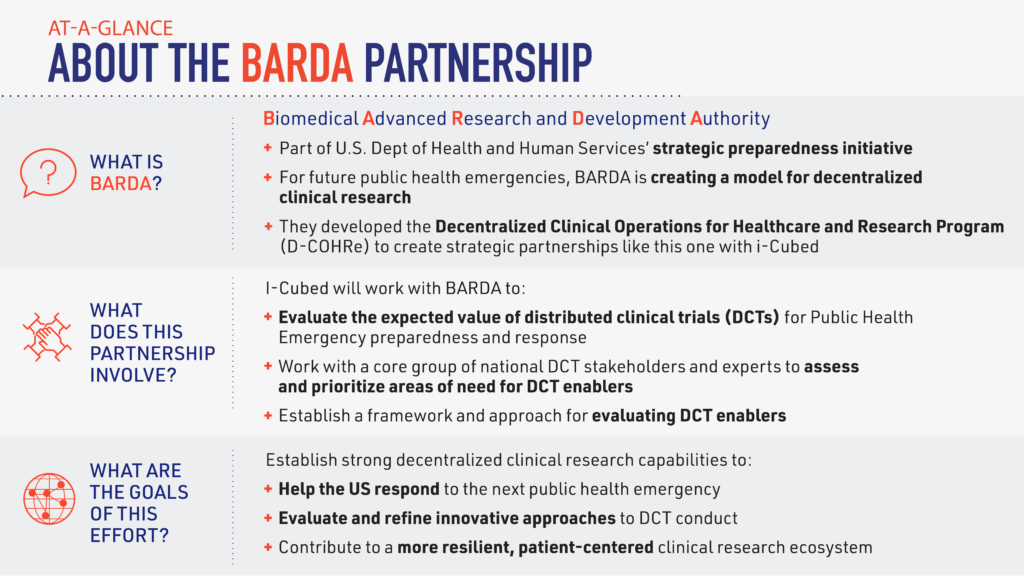
Through this partnership, DCRI and BARDA aim to stimulate and accelerate expansion of decentralized clinical study capabilities to facilitate public health emergency preparedness and response and create a more resilient, adaptable, and patient-centered clinical research ecosystem, ultimately enhancing the nation’s ability to respond to public health crises.
This project has been funded in whole or in part with federal funds from the Department of Health and Human Services; Administration for Strategic Preparedness and Response; Biomedical Advanced Research and Development Authority; Division of Research, Innovation and Ventures (“DRIVe”), under contract number: 75A50124C00056.
About i-Cubed
i-Cubed™ is the center for clinical research innovation, powered by the unique expertise and resources of the Duke Clinical Research Institute. i-Cubed supports individuals, teams, and organizations in turning their ideas into tools, technologies, and processes that transform how clinical research is done — for the benefit of people everywhere.
For more details about this partnership or to explore collaboration opportunities, please contact us at icubedcenter@duke.edu.