
December 9, 2024
i-Cubed Helps KidsHeart App Expand Care for Infants with Congenital Heart Disease
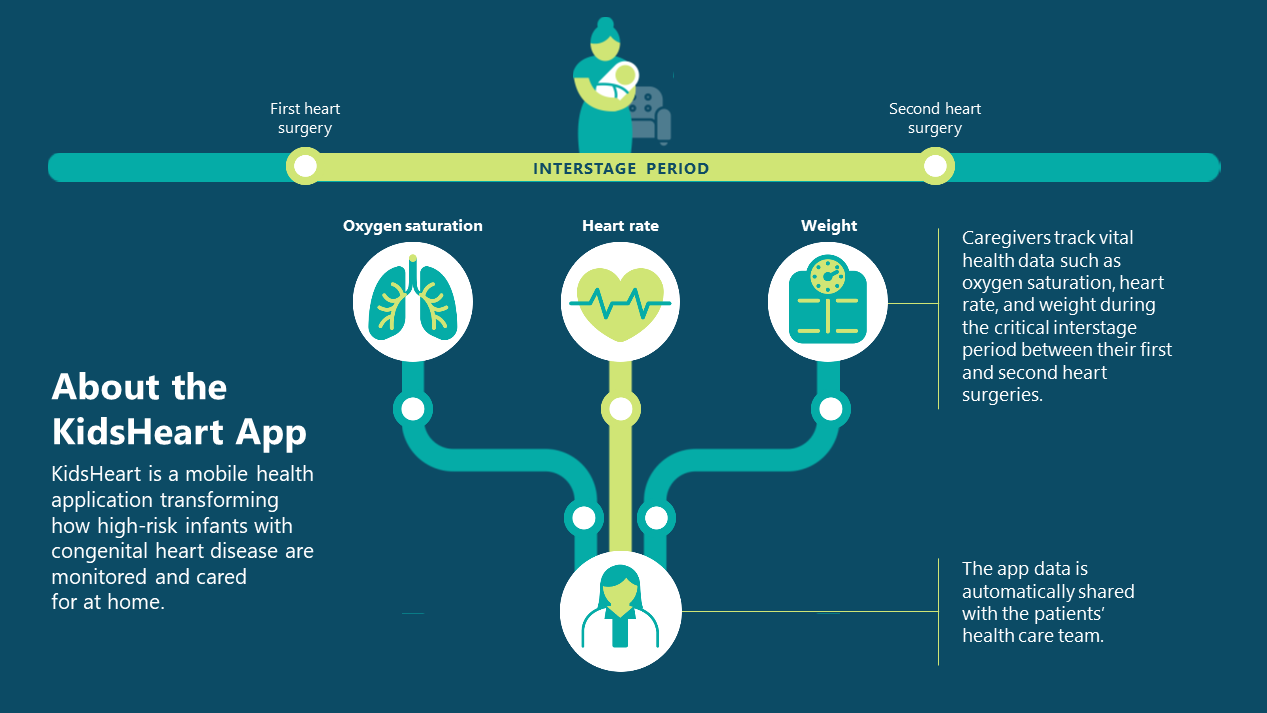
A new app that can revolutionize pediatric care for infants born with single-ventricle heart disease will soon have a larger reach thanks to support from i-Cubed, the center for clinical research innovation at the Duke Clinical Research Institute (DCRI).
Infants born with severe congenital heart defects such as Hypoplastic Left Heart Syndrome (HLHS), Pulmonary Atresia, or Tricuspid Atresia face one of the most vulnerable periods of their lives between their first and second heart surgeries, known as the interstage period. KidsHeart is a mobile health application that allows caregivers to track vital health data such as oxygen saturation, heart rate, and weight from home during this critical stage. Data is then automatically shared with the patient’s healthcare team, who can respond immediately if they notice any abnormal readings.
The KidsHeart team, with strategic support from i-Cubed, worked to refine the app’s technology to increase ease of use, and conduct rigorous market feasibility assessments in preparation for commercialization. i-Cubed supports the development of sustainable, fundable startups through comprehensive resources, expert mentorship, and access to a network of resources. “i-Cubed has been instrumental in helping us understand the potential business opportunities for our solution. Their support has allowed us to fine-tune KidsHeart for broader application,” said pediatric cardiologist Christoph Hornik, MD, PhD, MPH.
KidsHeart was developed by Dr. Hornik, pediatric nurse practitioner Sarah Tallent, DNP, CPNP-AC, and Kevin Hill, MD, MHS, Chief of Pediatric Cardiology at Duke Pediatric and Congenital Heart Center, as an app-based clinical tool to power research studies. With engaged feedback from patient families, they built KidsHeart into a user-friendly home monitoring and data collection tool for caregivers.
Managing at-home care can be a challenging and stressful time of uncertainty for patient families, leading to an average of 2.7 emergency room visits per patient in this population. The app is transforming how high-risk patients are monitored and cared for at home, allowing for early intervention and improved outcomes. After a 2022 pilot study at Duke showed a 55% reduction in emergency room visits for KidsHeart patients, the KidsHeart team sought collaboration with i-Cubed to explore commercialization opportunities and scale the app for broader use. i-Cubed helps innovators at Duke bring their solution to life – bridging the gap between research and practical application.
Tallent reflected on her experience working in the cardiac intensive care unit (CICU), "I was all too familiar with how devastating missing subtle signs of worsening clinical status could be, so our goal [with KidsHeart] was to catch issues early before they escalated into emergencies,” she said. Dr. Hill reiterated, “This digital health approach has allowed us to stay better connected to our patient families. We get more real-time feedback on their child’s progress, allowing us to keep a closer tab on some of the subtle clinical markers and intervene more quickly when we need to.”
For families navigating the challenges of caring for an infant with congenital heart disease, KidsHeart is more than just a monitoring or research tool—it offers peace of mind, knowing that early intervention is just a tap away. Jill Brawley, mother to KidsHeart patient Maya, shared her experience: “For that crucial first year, the KidsHeart app gave us the ability to closely monitor any changes that would imply that adjustments were needed in Maya’s care. This allowed her providers to act quickly... which helped us avoid a decline in her heart health. As a parent, you want to know every aspect of your child’s health is covered – and with the help of the KidsHeart App and our Duke providers, we had complete confidence that Maya was being thoroughly cared for.”
Currently, 85% of Duke’s families with interstage, high-risk infants use KidsHeart, and the team plans to expand its use to other hospitals nationwide. The long-term vision for KidsHeart includes applying its technology to other high-risk pediatric populations and further augmenting the app’s research capabilities, for which the team will leverage the clinical research expertise of i-Cubed and the DCRI. “These tools can power research in patient populations that have been challenging to capture data from in an outpatient setting. Additionally, I think digital health tools like this can help develop predictive models of risk stratification, enabling clinicians to reduce mortality and ultimately improve the quality of life for pediatric patients,” Tallent said.
Update:
New research, published in Cardiology in the Young, shows that infants with congenital heart defects who were monitored at home with the i-Cubed innovation, KidsHeart, experienced fewer ER visits and better weight-gain outcomes. Read the full study here: duke.is/7/6tmt
About i-Cubed
i-Cubed™ is the center for clinical research innovation, powered by the unique expertise and resources of the Duke Clinical Research Institute. We support individuals, teams, and organizations in turning their ideas into tools, technologies, and processes that transform how clinical research is done — for the benefit of people everywhere.
Contact:
icubedcenter@duke.edu