March 17, 2026
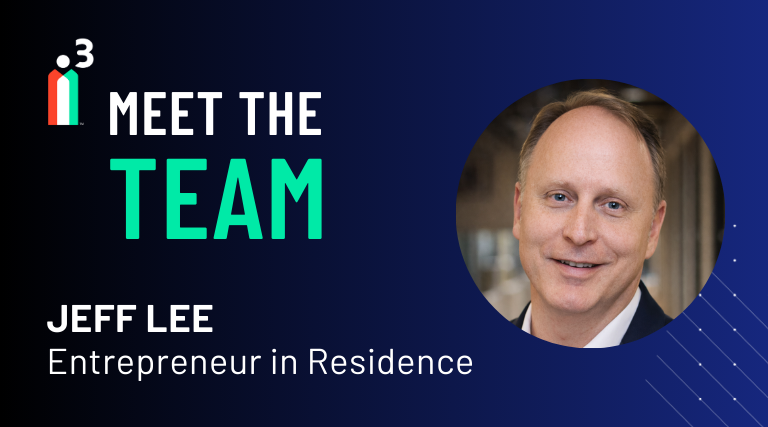
Meet the Team: Jeff Lee, Entrepreneur in Residence
What drew you to the Entrepreneur in Residence (EIR) role at i-Cubed?
I’ve collaborated with DCRI/CTTI in the past and have been consistently impressed with the caliber of the staff and leadership. Helping to guide and shape early-stage concepts allows me to leverage learnings from my prior startup experience and stay engaged with dynamic founders.
How would you describe your role as an EIR?
Helping teams evaluate nascent product concepts by incorporating customer and user perspectives; guiding founding teams through initial go-to-market approaches.
What early questions do you ask to help teams define their path and move from concept to something tangible?
Does the functionality we want to build constitute a new company, or is it more realistically a feature of someone else’s existing product?
Why is “right now” (as opposed to last year or next year) THE opportune time for this new product (i.e., what is the disruptive event that makes this a uniquely perfect time to build this)?
What is your “right to win” or unfair advantage that makes you the right founder to bring this product to life?
What’s the most common early misstep you see in startup thinking, and how do you help teams course-correct?
Founders tend to over-index on optimism. They’re often ‘dreamers,’ and this quality gives them the motivation to persevere in the challenging startup journey. Often, I find that this bias for optimism creates a tendency to pay more attention to the positive feedback on their ideas and turn a blind eye to the negative signals and competitive threats.
How do you guide teams to think about product-market fit, particularly in the healthcare space?
I highly recommend having as narrow an MVP (minimal viable product) as possible. This allows you to get into the market quickly, develop trust with customers, and use the early deployments to gain insights that will allow you to refine the product to be even more differentiated and aligned with customer needs. Founders are often tempted to ‘boil the ocean’ and spend more time building product than they do listening to customers. I believe that for every startup that nailed product market fit using the first generation of their product, there are dozens of companies that succeeded through refining their product gradually over time, steadily making themselves indispensable to their customers.
What lessons about execution and growth have stayed with you across your work?
I’ve generally been involved with ‘lightly capitalized’ or outright bootstrapped businesses. I believe in running lean and building responsibly based on actual customer revenue (rather than VC funds). I believe that customer trust is an undervalued ‘moat’ against competition. Building a great team of people who take care of the customer (and each other) can result in long-term, mutually beneficial relationships that do more to keep you ahead of competitors than anything else.
What excites you about AI’s potential in this field - and what concerns you?
Clearly, AI creates endless opportunities to transform clinical trial conduct. That said, it’s much harder to grow a successful start-up in the era of ‘vibe-coding’ and rapid software development. Once you identify an unserved need, it’s quite likely that multiple other startups and incumbents are going to develop the same functionality that you’re working on. While I prefer bootstrapped or lightly capitalized businesses, getting funded properly at an early stage may be a critical determinant of success.
What’s a fun fact people may be surprised to learn about you?
Before getting into the startup world, I worked for a time at Mars Inc., at the plant where M&Ms are made. A (not so) fun fact is that, on humid days, freshly-made chocolate smells almost exactly like vomit.
ADDITIONAL
- Meet the Team: Jeff Lee, Entrepreneur in Residence March 17, 2026
- i-Cubed Demonstrates AI-Driven Clinical Trial Automation in Major Proof-of-Concept Study February 2, 2026
- Meet the Team: Tom Collopy, Entrepreneur in Residence November 20, 2025