November 20, 2025
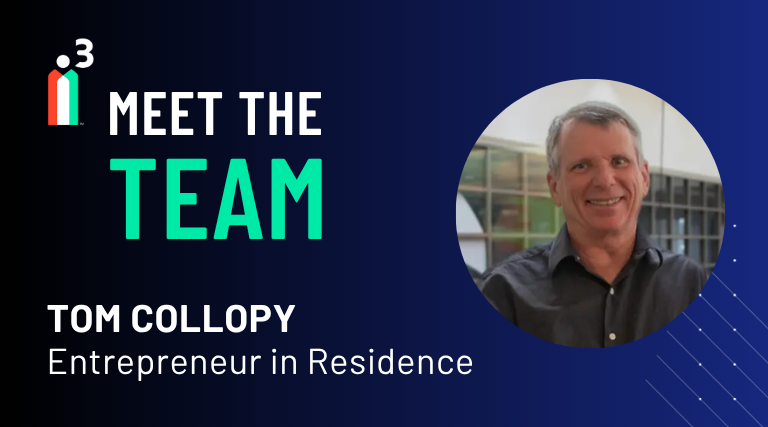
Meet the Team: Tom Collopy, Entrepreneur in Residence
What brought you to the Entrepreneur in Residence (EIR) role at i-Cubed?
I was introduced to i-Cubed through Donna Parker, though I wasn’t sure why at first. We met at an event where I was speaking to founders and innovators in the startup space. It turns out my experience aligned with what she thought could be valuable to i-Cubed.
You can probably tell from my gray hairs that I’ve been through a lot as an innovator, sometimes succeeding, but often learning through failure. That’s what I bring to i-Cubed: experience gained the hard way.
When I left corporate life, I wanted to help founders avoid the mistakes that come with inexperience. I believed I had something useful to offer. I didn’t get it right at first, but I’ve spent the past nine years trying to do just that.
I work best with founders who approach things with an open mind, who are willing to listen, reflect, and decide what's right for them. Donna approached me that way, and when I met Mickey, he was the same. That openness made me think, "I’m going to learn a lot here, and maybe they’ll consider what I have to offer." That’s what drew me in.
How would you define your role as an EIR?
At a high level, it means bringing experience to the table and using it to support others. What I’ve come to understand at i-Cubed, is that the leadership team genuinely values diverse voices in the room to help make better decisions. So, I see myself as a voice of experience, whether I’m working directly with an innovator or with the i-Cubed leadership team. My role is to bring in ideas that come from having lived through the startup process and offer them for others to consider.
What’s the most common early misstep you see in startups, and how do you help teams course-correct?
One of the biggest early challenges I see is the tension between a founder’s belief in their solution and what customers actually want.
Most founders believe that if they solve a problem, people will naturally want to buy the solution, but that’s not always true. The real challenge isn’t building the solution, it’s learning how to sell it. Startups usually fail, not because they couldn’t build something useful, but because they couldn’t get others to see its value.
Founders often lead with, “Here’s the problem, and here’s my solution with all these great features,” but customers don’t think that way. They have to feel the problem is worth solving, and that your solution is the right fit for them. That emotional connection is critical.
The biggest shift I try to help founders make is going from being builders to being sellers. And then I help them learn how to actually sell. That’s been the most consistent challenge I’ve seen over the past nine years.
Can you tell me more about your work outside of i-Cubed and your background in startups?
People often ask me what I do day-to-day, sometimes in the presence of my wife. She usually laughs and says I’m retired. But the truth is, everything I do centers on solving complex problems. That’s what my brain loves.
I teach two entrepreneurship classes at the University of North Carolina at Chapel Hill. One focuses on building a startup from scratch, and the other teaches how to build a sales funnel. That second course involves student founders with real startups, which gives me a great lab to keep learning what works and what doesn’t.
I also guest lecture at North Carolina State University, mostly on using AI in the startup space. I run three different sessions there, which I especially enjoy because I don’t have to grade anything!
I volunteer with accelerators like NC IDEA, a nonprofit in North Carolina that offers grants and runs startup programs. I usually come in to talk about customer discovery, which is really about figuring out how to sell.
Lastly, I’m a partner in an AI consulting company. We help businesses figure out where AI fits and how to use it more effectively. Again, it’s all about solving complex problems and helping others do the same.
Across all these roles, I’m teaching and learning. I even wrote a book on using AI to build a startup and created 33 guides on applying AI in that context. Writing is another way I teach and figure out what I actually understand!
So the simple answer is: I try to help people. I just do it in a lot of different ways.
What’s your perspective on AI’s role in innovation?
AI is on everyone’s mind right now. For me, what’s exciting is how AI transforms learning and advising. I first saw this as a teacher; when you’re in front of a classroom and you see students disengaged, you realize the old model of “I teach, you absorb” doesn’t quite work anymore. But when AI entered the picture a few years ago, everything shifted. I saw the potential for students to use AI as both an educational tool and an advisor.
If I provide the right context, AI can quickly surface what’s most important and even guide me through the next steps. That’s how the guides in my book are structured; students use prompts not just to learn, but to figure out how to do something. Teaching today is really about helping people communicate more clearly and ask better questions. If you don’t give AI enough context, it might hallucinate. That’s not a problem with the tool; it’s a signal that you need to be more specific.
As someone who’s not a natural writer, I find AI incredibly freeing. A guide that once took me three or four days to write now takes an hour. I can share what I know with the world much faster.
That said, there are concerns. One of the biggest concerns I hear in consulting is the fear of job loss. But I believe AI won’t take away jobs as much as it will change how we do them. It’s a powerful assistant, not a human replacement. AI can offer options, but humans still need to judge what’s right. And the quality of the output depends entirely on the quality of the prompt, which comes from human expertise.
I’m not particularly worried about data sharing or copyright with AI. Every generation faces new technology, PCs, the internet, smartphones, and we adapt. I view AI in much the same way: a tool that rewards those who learn how to use it responsibly and effectively.
What has surprised you most about working with i-Cubed?
Coming into i-Cubed, I didn’t know much about clinical research, but what immediately struck me was the mindset of the leadership. They are deeply committed to helping innovators bring ideas into the world that can make a real difference. That commitment shows up in their decisions and in the culture they’ve built. It’s not just talk – they’re all in.
Another thing that impressed me is how busy and accomplished the team is, and yet they’re passionate and fully engaged. They don’t do this work for recognition or money, it’s about impact. They genuinely want to help innovators succeed, and that’s rare.
The ideas themselves are impressive, too. I’ve advised startups for nearly a decade and seen hundreds of concepts. The ones I see at i-Cubed have the potential to improve lives, whether that means helping people live longer, live healthier, or just have a better day-to-day experience. The best innovators are those who stay open to letting their ideas evolve. At i-Cubed, I see that openness all the time.
How do you help teams define their path and move from concept to something tangible?
A lot of innovators start with a vision and a set of beliefs. Early on, they reach a fork in the road. One path is: “I know the answer, I just need to execute.” The other is: “Let me test what I believe and find out what’s really true.”
Those who follow the first path often end up burned out, frustrated, and stuck in what I call the “coffee shop conversation” where they’re ready to quit. The second path, the one grounded in curiosity and customer discovery, is harder but leads to better outcomes. It’s not about getting people to love your idea, it’s about discovering what people need, and being willing to adapt your solution accordingly.
In your opinion, how do you build innovation cultures that last?
In big organizations, innovation can be tough. There’s bureaucracy, risk aversion, and a tendency to stick with what works. I spent 33 years in large corporations and got lucky. I found myself in two pockets of real innovation at IBM and Qualcomm. I’ve always had a bias toward fixing problems, trying new things, and making my job easier. But not everyone has that freedom.
That’s where i-Cubed comes in. It creates a safe place within a larger system where it’s okay to think differently. It encourages people to imagine, test, and refine new ideas without fear. That alone makes a huge difference. Combine that with tools like AI, and now you’ve got something powerful. Large language models can help you identify potential users, understand problems, and evaluate ideas, all without judgment.
At its core, i-Cubed gives people permission to explore ideas in a structure that supports and protects innovation. That’s exactly what I had at IBM and Qualcomm. When that structure exists, innovation flourishes.
Outside of work, what’s something you love to do that recharges or inspires you?
People who know me know I spend a lot of time using ChatGPT. I’m a problem solver at heart, and prompting is my creative outlet. But I also know my brain needs downtime. I need space to just think, to let ideas settle, to recharge, and to step away from the constant buzz. That quiet space is where the next big idea usually shows up.
First, I love hitting golf balls. Golf is a hard problem to solve; there’s always something to tweak, improve, or rethink. It keeps my brain engaged in a different way.
Second, I love being on the water. A lot of people don’t know this, but I have five different human-powered watercrafts. I’m lucky to live on a lake, and getting out there with no devices, no distractions, just movement and water, is incredibly calming for me. That’s my reset button.
What’s a fun fact people may be surprised to learn about you?
Well, if you were standing here with me, you’d notice I’m not very tall. So, when I tell people I used to run hurdles, they’re usually surprised.
In high school, I ran cross country in the fall, but I didn’t like running in circles on a track. I wanted something different, and despite hurdles being designed for tall people, I was stubborn enough to stick with it. I went from being pretty bad to being pretty decent. It’s a good reminder that sometimes, what doesn’t “fit” at first can still work if you’re determined enough.
Do you have any advice for potential innovators?
If you’re a founder or innovator, especially someone new to this space, it’s normal to feel fear – fear of putting your idea out there, fear of not knowing what you’re doing, fear of failure or rejection. And when you have a full-time job, a family, a busy life, it’s easy to ask, “Why take the risk?”
I think something’s missing in me because I don’t have that fear, but I know many do. That’s why i-Cubed exists. It’s a place built to help you push past that hesitation. Whether you’re working with me as an EIR or with the leadership team, we’re here to help you fill in the gaps, take smart steps, and see how far your idea can go.
So, if you're on the fence, tamp down the fear, and just ask!